
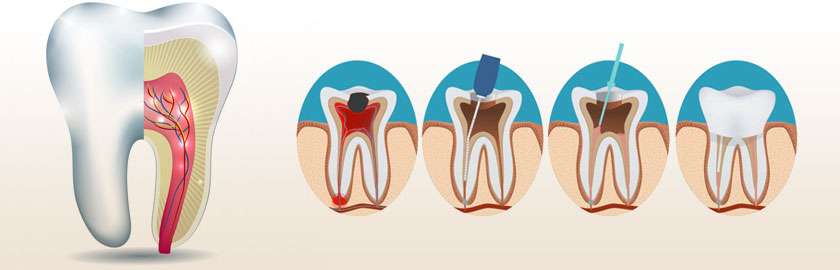
Endodontics (canal treatment) is the name of the branch of dentistry that deals with the diagnosis and treatment of diseases related to tooth root canals, dental pulp (nerve tissue) and tissues surrounding the tooth.
The purpose of endodontics (root canal treatment) is to keep the tooth in the mouth for a long time. It is a form of treatment applied to teeth that are hypersensitive to hot and cold foods and have night pain.
In root canal treatment, living tissues (nerve and vessel) in the root canal of the tooth are removed and the canal cavity is cleaned with disinfectant solution and canal files. The canal cavity is filled with biocompatible materials in a leak-proof manner.
 How does the dental pulp become inflamed?
Bacteria found in the oral cavity of every person combine with many foods that are taken, resulting in the formation of acids in our mouth. If these formed acids cannot be removed from the mouth with a good oral care, the tooth enamel is damaged and caries occurs. If the caries formed on the tooth enamel are not treated, it progresses to the dentin layer under the enamel layer and from there to the pulp. After a while, microorganisms destroy the vessels and nerves in the pulp and cause inflammation.
Another way pulp inflammation can occur is trauma caused by a blow to the tooth. Trauma causes the veins and nerves entering the root of the tooth from the root tip to rupture and the tooth loses its vitality. The addition of microorganisms to this situation by any means also causes inflammation of the pulp.
Another way the pulp can become infected is the presence of long-term periodontal (gum and surrounding) disease around the tooth.
How to understand that the dental pulp is inflamed?
The presence of a sensitivity to hot and cold foods and beverages in the teeth, the occurrence of severe pain during eating or the sudden onset of severe pain and the inability to respond to painkillers indicate an inflammation or the onset of an inflammation.
Again, excessive color changes in the teeth can also be perceived as a sign of inflammation. Apart from these, it is another indicator that the patient feels pain when the tooth is struck on the teeth where the caries has reached the pulp but has not been treated, or in cases that have been made before but have been unsuccessful.
In such cases, the endodontist may use options such as root canal treatment, restoration of endodontically treated teeth, renewal of unsuccessful root canal treatments, and whitening of teeth that have darkened after root canal treatment.
 What are the stages of root canal treatment?
The first step for root canal treatment is radiography and intraoral examination. With the examination, the problematic tooth is detected. If the tooth is alive, it is aimed to destroy the sensitivity of the tooth and surrounding tissues by applying local anesthesia. If there are previous restorations on the tooth to be treated, they are removed. The caries in the enamel and dentin layers are cleaned and a cavity is created to reach the pulp.
Working length is determined using electronic instruments and by radiography. Infected dentin layers and microorganisms in the root canal are destroyed and removed using rotary instrument systems. In the meantime, microorganisms are destroyed with various root canal disinfectants.
One of the most important elements of a successful root canal treatment is good upper occlusion. In some cases, if there is excessive substance loss in the tooth, after the root canal treatment, post-core treatment can be performed to increase the durability of the tooth.
In cases where there is no inflammation at the root tip, root canal treatment can be finished in a single session. In cases where there is an infection at the root tip or the tooth is dead, a special drug is placed in the root canals and waited for a week. If there is no discharge from the root tip at the end of this period, the treatment can be finished. In stubborn cases, this application can be repeated for a few weeks. When there are no signs of inflammation in the canals, the root canals are hermetically and sealed, and the root canal treatment is completed.
After the treatment is completed, pain may be observed in the tooth, which lasts for a few days and occurs when pressing on the tooth. This is a normal pain that occurs after root canal treatment. With a little protection of the root canal treated tooth, it disappears in a short time.
According to statistics, the success rate of root canal treatments performed in accordance with the procedures is over 90%. This success rate is reduced to 70-80% in teeth with repeated root canal treatment.
